

Sponsored content disclosure: Stinger Media Limited paid Token Metrics to sponsor this article and publication. Token Metrics retained editorial control over the final text.
Crypto Plinko and Dice games look simple: choose a stake, set the available risk controls, and wait for the result. Their simplicity can also make the important differences easy to miss. The payment asset, game rules, return-to-player figure, house edge, licensing status, and withdrawal terms all need separate checks.
This guide explains how Plinko and Dice generally work, how USDT differs from SOL, and what to verify before using a crypto-focused casino. It does not rank or endorse any operator.
Crypto Plinko and Dice: the key points
- Both are primarily games of chance. Choosing a target, row count, or risk setting can change volatility and payout distribution, but it does not remove the house edge.
- USDT and SOL are not the same type of asset. USDT is designed to track the US dollar. SOL is the native asset of the Solana network and its market price can move materially.
- RTP and “provably fair” claims are product-specific. A figure published for one game or casino should not be applied to every version.
- Blockchain payments do not prove casino safety. On-chain settlement is separate from licensing, game integrity, custody, withdrawals, and customer-service quality.
USDT, Tether, and Solana are different
USDT (USD₮), Tether’s dollar-denominated token, is a stablecoin designed to maintain a value close to one US dollar. Tether states that USD₮ is pegged 1:1 to the dollar and supported by its reserves. That design can reduce exposure to price swings compared with a non-stable crypto asset, although it does not eliminate issuer, custody, platform, or regulatory risk.
SOL is different. It is the native asset used by the Solana network for transaction fees and other network activity. SOL is not dollar-pegged, and its price can rise or fall between a deposit, a wager, and a withdrawal.
The distinction matters in practice. Someone funding an account with SOL can experience both the gambling outcome and a change in SOL’s market value. Someone using USDT reduces that particular price-volatility exposure, but still faces the casino’s rules, fees, processing times, and counterparty risk.
A directory such as USDT Casinos may help readers identify platforms that claim to accept USDT. A listing is only a starting point. Confirm the operator’s current licence, terms, restricted countries, withdrawal rules, and responsible-gambling controls directly before depositing.
How Plinko works
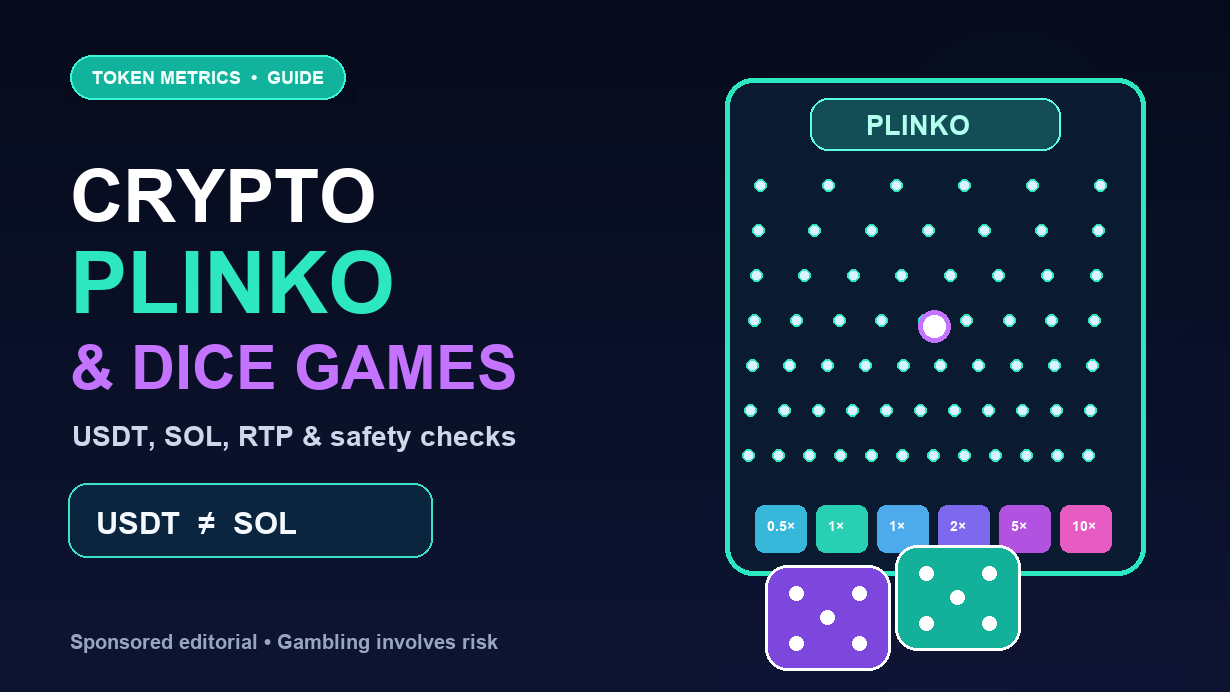
Plinko normally uses a virtual peg board. A ball is released from the top, moves through rows of pegs, and lands in a payout slot at the bottom. The available controls vary by product, but often include stake size, number of rows, and a low-, medium-, or high-risk setting.
Those settings change the distribution of possible outcomes. A higher-risk configuration may place larger multipliers at the edges while making them less likely to occur. Lower-return positions can produce a partial loss or a total loss of the stake, depending on the specific payout table.
Plinko should not be described as skill-based merely because a player selects a risk level or row count. Those choices can alter volatility and win probability, but the result remains governed by the game’s mathematical model and randomization system.
How crypto Dice games work
A common Dice format asks the player to choose a numerical target and wager that a generated result will fall above or below it. Moving the target changes the probability of winning and the associated payout multiplier.
For example, choosing a result with a higher probability usually produces a smaller potential payout. Choosing a less likely result usually produces a larger multiplier. The exact range, rounding rules, payout formula, and house edge differ between products.
As with Plinko, changing the target is a risk-and-payout choice rather than evidence that skill can overcome the house edge. Read the specific game rules instead of relying on a generic description from another operator.
RTP, house edge, and “provably fair” claims
Return to player, or RTP, is the theoretical share of wagered money a game returns to players over a very large number of plays. House edge expresses the corresponding mathematical advantage retained by the game. Neither figure predicts the result of an individual session.
Some Plinko and Dice products publish a 99% RTP or 1% house edge. Those numbers may be accurate for the named product and settings, but they should not be generalized. Always use the figure displayed in the current rules for the exact game being played.
On products that implement it, “provably fair” can describe a cryptographic method that lets a player verify whether a result was generated from disclosed server and client inputs. It can improve result transparency when implemented correctly, but it does not establish that the casino is licensed, solvent, secure, or reliable. A licence also does not automatically prove that a game’s cryptographic verification works as advertised.
Checks to complete before choosing a crypto casino
Before creating an account or transferring crypto, verify the following:
- Legal availability: confirm that online gambling and the operator are permitted where you live. Do not treat the absence of your country from a restricted list as proof of local authorization.
- Licence details: identify the legal operator, regulator, licence number, and current status. Verify them against the regulator’s own records where possible.
- Game rules: check the exact RTP, house edge, payout table, risk settings, and verification instructions for the product you intend to use.
- Deposits and withdrawals: review supported networks, minimums, maximums, fees, confirmations, identity checks, and processing conditions. Sending an asset on the wrong network can result in permanent loss.
- Bonus terms: read wagering requirements, eligible games, maximum-bet rules, expiration dates, and withdrawal restrictions before accepting a promotion.
- Account controls: look for deposit limits, time-outs, self-exclusion, session history, and accessible support. These controls should be available before a problem develops.
- Security: use a unique password and multifactor authentication where available. Never assume that a crypto deposit makes an account or platform secure.
Responsible play matters more than payment speed
Fast crypto settlement can be convenient, but it can also make repeated deposits easier. Set a fixed entertainment budget before playing, never borrow to gamble, and do not chase losses. Stop if play is affecting finances, work, relationships, or mental health.
People who are under the legal gambling age, located in a prohibited jurisdiction, self-excluded, or unable to control their gambling should not use these products. Local responsible-gambling organizations can provide confidential support and exclusion resources.
Bottom line
Crypto Plinko and Dice are simple games of chance offered in many different implementations. USDT may reduce exposure to crypto price volatility compared with SOL, but neither asset makes a game fair or an operator trustworthy.
Judge each product by its current rules and each casino by its verified legal entity, licence, geographic availability, withdrawal terms, security controls, and responsible-gambling protections. Treat directories, promotional claims, and “provably fair” labels as leads to investigate rather than substitutes for due diligence.
Sources
- Tether: Transparency and reserve information
- Solana: Introduction to Solana tokens
- UK Gambling Commission: return to player and house edge
- Chainlink: provably fair randomness and its limitations
- GambleAware: safer-gambling information and support
Source check completed August 13, 2026. Product rules, licences, and geographic restrictions can change.