

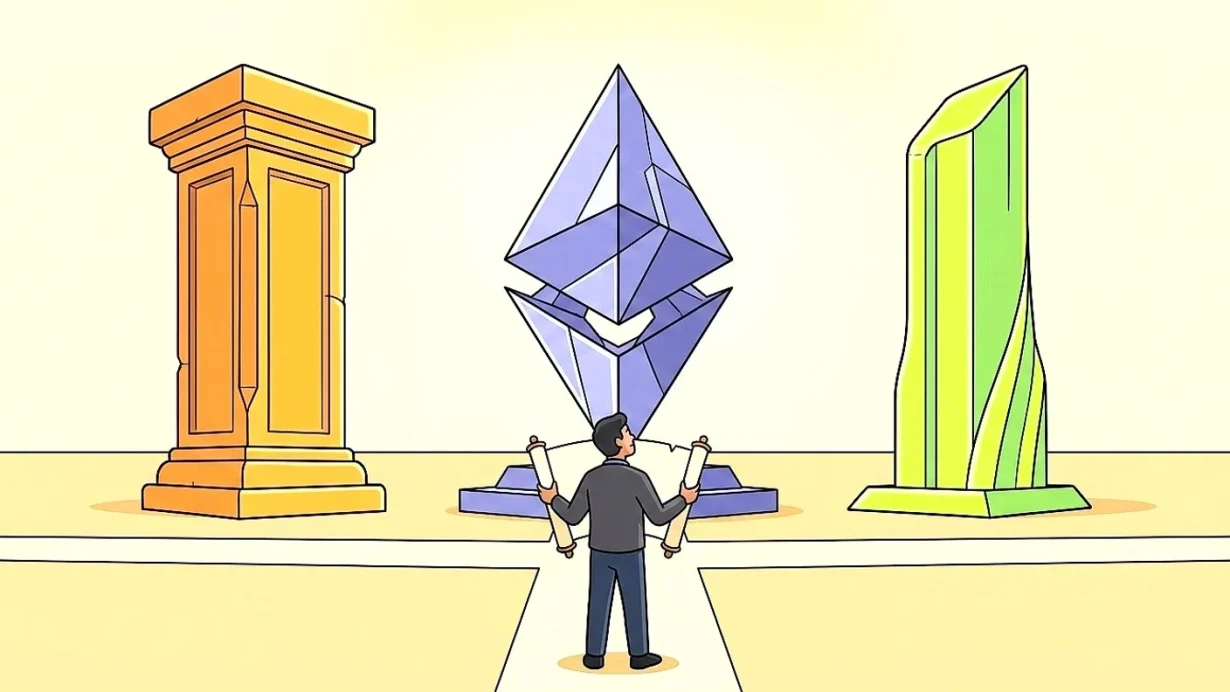

Quick answer: Bitcoin, Ethereum, and Solana solve different problems. Bitcoin emphasizes scarce digital money and final transfers. Ethereum offers a broad app network and layer-2 scaling. Solana targets low-cost, high-throughput apps. Start with your use case, not a price forecast.
Bitcoin vs Ethereum vs Solana: quick guide
Bitcoin
- Purpose: digital money and final transfers.
- Consensus: proof of work.
- Supply: fixed maximum of 21 million BTC.
- Scaling: conservative base layer plus payment layers.
- Main tradeoff: limited base-chain throughput.
Ethereum
- Purpose: general-purpose apps.
- Consensus: proof of stake.
- Supply: dynamic issuance with fee burning.
- Scaling: base layer plus rollups and other layer-2 networks.
- Main tradeoff: more layers and bridge risk.
Solana
- Purpose: fast, low-cost apps.
- Consensus: proof of stake with proof-of-history timing.
- Supply: inflationary issuance that declines under its schedule.
- Scaling: high-capacity base layer.
- Main tradeoff: higher node hardware demands.
Choose by use case
- Consider Bitcoin when the priority is a mature money network, fixed maximum supply, high trading volume, and a simpler base-chain purpose.
- Consider Ethereum when the priority is app depth, DeFi, stablecoins, tokenization, or access to a large layer-2 network.
- Consider Solana when the priority is low transaction cost, fast app interactions, and a fast base layer.
This is a network-fit framework, not a ranking or buy recommendation. A useful network can still have an overpriced token, unsafe app, or unsuitable custody setup.
Bitcoin: digital money first
Bitcoin uses proof of work. Full nodes apply shared consensus rules and keep their own validated copy of the transaction history. The design favors predictable rules and resistance to changing past records.
Bitcoin has a fixed maximum supply of 21 million BTC. New coins enter circulation through mining rewards that decline over time. Its focused design limits base-chain throughput. Users should compare final transfer time, fees, custody, and any second-layer rules.
Ethereum: smart contracts and layer-2 scale
Ethereum uses proof of stake. Stakers deposit ETH, check blocks, and can lose funds for dishonest behavior. Ethereum supports apps, tokens, and finance tools.
Ethereum also relies on layer-2 networks to move work away from the main chain. They use Ethereum to settle transfers or post data. Users must check bridge design, fees, and withdrawal rules for the exact layer 2 they use.
Solana: fast base-chain apps
Solana combines proof of stake with proof-of-history timing. Transactions can contain several instructions and execute atomically: if one instruction fails, state changes revert, although fees can still apply.
Solana is designed for low-cost, frequent interactions. That can suit trading, payments, games, and consumer apps. Users should still review node spread, client diversity, network uptime, app security, and transaction limits.
How to compare performance without hype
- Define the job. Separate holding, payments, final transfers, trading, and app use.
- Use current network data. Check fees, active use, node or miner spread, and uptime from primary sources.
- Separate base layer from scaling layers. A rollup, payment channel, or app can add different trust and withdrawal assumptions.
- Inspect the asset model. Compare issuance, fee burning, unlocks, staking, and who receives rewards.
- Test custody and app risk. A secure network does not make every wallet, bridge, token, or smart contract safe.
Risk checklist
- Bitcoin: custody errors, fee spikes, mining spread, and second-layer tradeoffs.
- Ethereum: app exploits, bridge risk, staking penalties, layer-2 fragmentation, and variable fees.
- Solana: app exploits, node requirements, client spread, and network uptime.
- All three: price swings, scams, new rules, hard-to-trade markets, and permanent transaction mistakes.
The Investor.gov crypto asset alert warns that crypto investments can be volatile, illiquid, and exposed to fraud. This guide does not prove that an asset is safe.
Use Token Metrics for repeatable research
Network design explains what an asset can do. Market and risk data help show how the asset is behaving now. Compare trend, ease of trading, token grades, and risk before making a decision.
Compare crypto market and risk research in Token Metrics
Frequently asked questions
What is the main difference between Bitcoin, Ethereum, and Solana?
Bitcoin centers on scarce digital money and final transfers. Ethereum is a general-purpose app network with many layer-2 tools. Solana is an app network built for low-cost, high-throughput use.
Is Solana faster than Bitcoin and Ethereum?
Solana is designed to process more activity at lower base-chain cost. Raw speed does not measure decentralization, security, ease of trading, or app risk.
Which is safer: Bitcoin, Ethereum, or Solana?
There is no single safety score. Compare network history, node or miner distribution, client diversity, custody, app exposure, and the exact app being used.
Sources
- Bitcoin Developer Guide: blockchain and consensus rules.
- Bitcoin.org: issuance and maximum supply.
- Ethereum.org: proof of stake.
- Ethereum.org: layer-2 scaling.
- Solana documentation: transactions.
- Solana documentation: fees.
Disclosure: This guide is educational. It is not investment, legal, or tax advice. Token Metrics may earn revenue when readers buy its products.