


TL;DR
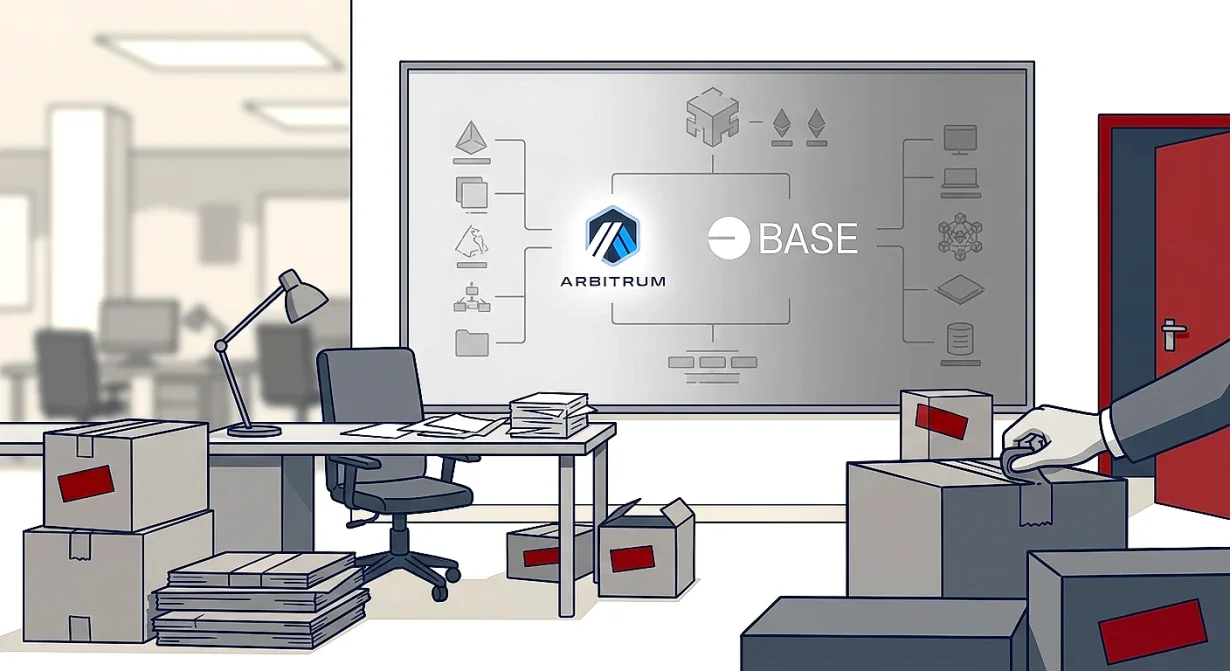
Syndicate Labs is closing after five years. The company built tools for on-chain communities, investment clubs, and rollup-based apps. Its shutdown is the latest in a string of crypto project closures this year. The rollup market has shrunk fast, and the survivors are mostly Base and Arbitrum.
Context
Syndicate Labs was not a token project. It was infrastructure. The company gave developers reusable tools to spin up rollup-based apps, on-chain investment clubs, and community contracts. That sounds niche. It was a real bet on a specific future: one where hundreds of app-specific rollups would need shared building blocks.
That future did not arrive. At least not the way Syndicate expected.
Rollups are networks that process transactions off a base blockchain, then post the results back to it. The idea was that many apps would want their own rollup. Instead, most developers chose to build on existing Layer-2 networks like Base and Arbitrum, which already had users, liquidity, and tooling. The market for “build your own rollup” infrastructure got squeezed from both sides: big platforms swallowed the generalist use cases. Bespoke app-chain builders went fully custom.
Syndicate co-founder Will Papper said the team considered a shift into rollup-as-a-service consulting. They decided against it. Demand had moved toward custom execution environments built for specific apps, not reusable middleware. That left Syndicate stuck in the middle. Too specialized for general infrastructure, too far from the execution layer to compete with custom app chains. Papper put it plainly in his announcement on X. “I wish we had a better path to customer and market traction. Unfortunately, we did not in this rollup market.”
Ryan Yoon, senior analyst at Tiger Research. Told Decrypt that the Syndicate Labs closure shows the rollup infrastructure market has consolidated around a few dominant Layer-2 networks. Base and Arbitrum now absorb most of the users and liquidity. Projects increasingly prefer subnets or existing infrastructure over building new Layer-2 networks from scratch.
The company said it chose an orderly wind-down to meet customer commitments and release its work for others to use on the Syndicate Network.
What’s New
Syndicate Labs announced the shutdown on May 21, 2026, via posts on X. The company said the rollup market had “fundamentally shifted,” making the decision necessary. For every new rollup spinning up, several more are quietly shutting down, the company wrote.
The closure adds to a wave of crypto project shutdowns this year. Gemini-owned NFT marketplace Nifty Gateway said in January it would close. DeFi lender ZeroLend said in February it would wind down after three years, citing an unsustainable business model. Step Finance, SolanaFloor, and Remora Markets also announced shutdowns in February, weeks after a $29 million hack. Magic Eden later moved its multi-chain wallet into export-only mode as it shifted away from earlier product lines.
The retrenchment is not limited to crypto. Coinbase said it would cut roughly 14% of its workforce amid weaker market conditions. Dune Analytics said it would cut 25% of its staff as it refocused on AI tooling and institutional crypto adoption. Meta planned to lay off about 8,000 employees as it increased AI spending. Adobe’s CEO announced plans to step down as generative AI tools threatened parts of the company’s business.
The pattern is consistent: companies are moving toward smaller teams, cutting roles tied to older workflows. Shifting resources toward AI and institutional products. Crypto infrastructure projects that depended on a fragmented rollup world are caught in a bad spot. The consolidation they were built to serve never fully materialized.
What Token Metrics Data Shows
Data as of May 21, 2026.
Token Metrics technicals on Bitcoin read bearish. The trend has flipped bearish, and Bitcoin is trading near the lower end of its recent range. Momentum is weak but not stretched to extremes. Volatility is moderate, so the market is not pricing in a dramatic near-term move in either direction. The trend is firm, not just drifting: the directional signal is strong enough to suggest this is not random noise. First support sits near $73,900, with next resistance near $81,400.
Bitcoin is trading near $77,000, off less than 1% on the day and down about 5% over the past week. Market cap sits at roughly $1.5 trillion.
On Polymarket, the market asking whether Bitcoin will dip to $35,000 in May is priced near 0.15% yes. That level is about $42,000 below current price. The market is not pricing in a crash, just a soft patch.
Token Metrics Daily Pulse flagged this story in its main items section.
What to Watch
- Rollup shutdown rate: If more rollup infrastructure projects announce closures in the next 30 days, it confirms the consolidation thesis. Watch for announcements from smaller rollup-as-a-service providers.
- Base and Arbitrum TVL: If total value locked on Base and Arbitrum continues to rise while smaller rollup networks lose ground, that confirms where developer attention is going. Both metrics are publicly trackable on DeFiLlama.
- Bitcoin support near $73,900: Token Metrics data puts first support near that level. A close below it on meaningful volume would be a signal worth watching for anyone tracking broader crypto market health.
- Funding environment for infrastructure projects: If venture funding rounds for early-stage crypto infrastructure slow further in Q2 and Q3 2026, expect more closures like Syndicate’s. Watch for data from Messari or PitchBook on deal counts.
- Coinbase and Dune staff reductions: Both companies cited AI adoption as a reason for cuts. If other mid-size crypto firms announce similar pivots in the next 60 days, the sector-wide restructuring is accelerating faster than most expect.
This article is for informational purposes only and does not constitute financial advice.