


TL;DR
Token Metrics data shows Bitcoin trading near $73,300 with a bearish trend bias, even as CME Group launches 24/7 futures trading. Three historical gaps remain open as liquidity shifts toward ETF options. CME Bitcoin futures and options now trade continuously on Globex, eliminating the weekend gap phenomenon.
Context
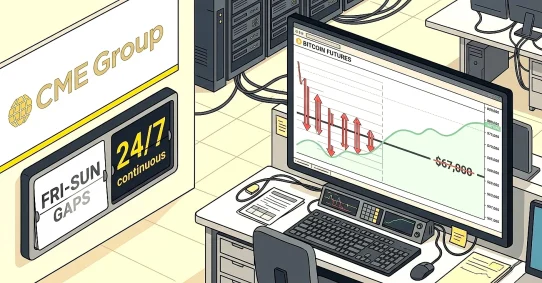
Bitcoin’s market structure just changed in a big way. For years, the Chicago Mercantile Exchange operated on traditional market hours. It closed Friday evening and reopened Sunday night. This created price gaps between CME futures and Bitcoin’s spot market, which never sleeps. Traders built entire strategies around these weekend gaps, betting on whether prices would snap back to fill the void.
These gaps became legendary in crypto. They showed up every time Bitcoin moved significantly over the weekend while CME was closed. Thin weekend liquidity made the moves even more dramatic. When institutional traders returned Sunday night, volatility would spike as futures prices scrambled to catch up with reality. It was a predictable pattern that many traders profited from regularly.
The problem went beyond speculation. Institutional players managing large Bitcoin positions couldn’t hedge their risk over weekends. If bad news hit Saturday morning, they had to wait until Sunday evening to react. This created real risk for asset managers, hedge funds, and corporate treasury departments. The weekend gap wasn’t just a trading quirk; it was a structural flaw in Bitcoin’s institutional market infrastructure.
Why gaps mattered
CME gaps weren’t just charts patterns; they reflected deeper market inefficiencies. Bitcoin trades 24/7 across global exchanges. But the biggest regulated futures market in the United States shut down every weekend. This disconnect created arbitrage opportunities and risk management challenges. Traders would watch Bitcoin’s spot price move over the weekend, then position for the inevitable gap fill when CME reopened.
The phenomenon became so reliable that retail traders built entire trading strategies around it. Social media accounts tracked every gap fill. Analysts predicted which gaps would get filled first. It was a weekly ritual in the crypto market. But it also highlighted how Bitcoin’s institutional infrastructure lagged behind its native market structure.
What Token Metrics Data Shows
Token Metrics technical indicators paint a bearish picture for Bitcoin. The trend bias has flipped negative, signaling downward momentum. Technical trend indicators suggest the market is in a bearish phase. The momentum indicator shows no clear directional signal, indicating uncertainty in short-term price movements.
Momentum indicators reveal weakening strength. The momentum gauge stands at 32.77, approaching oversold territory but not yet there. This suggests sellers have control but the asset isn’t extremely oversold. The trend strength indicator reads 22.57, indicating a weak trend rather than strong directional movement.
Volatility remains moderate. The volatility measure shows about 2.13% average daily volatility, suggesting normal price swings rather than extreme movements. The trend indicator confirms the bearish outlook, while the range indicator shows Bitcoin trading within its recent range rather than breaking out.
Support and resistance levels are clear. The first major support sits near $70,000, a key psychological level. Resistance appears around $79,600, which could cap any upward moves. Bitcoin currently sits in the middle of these levels, suggesting a period of consolidation.
The Polymarket consensus shows only a 0.1% chance of Bitcoin reaching $92,000 by May 31, which is about $18,700 above the current price. This token-market signal reinforces the bearish outlook from our technical indicators. Our Daily Pulse coverage classifies this as a market snapshot moment, capturing Bitcoin’s current state as it adjusts to new market structures.
What’s New
Starting Friday, CME Bitcoin futures and options trade continuously on Globex. This change eliminates the Friday-to-Sunday closure that created the weekend gap phenomenon. By aligning futures trading with Bitcoin’s native 24/7 structure, CME reduces weekend risk premia. Institutional investors can now manage exposure continuously instead of waiting for markets to reopen. This represents significant progress in Bitcoin’s integration with traditional financial infrastructure.
Despite this structural improvement, liquidity remains concentrated elsewhere. BlackRock’s IBIT ETF options open interest far exceeds CME crypto options markets. This imbalance helps explain why ETF options have become the preferred institutional tool for Bitcoin volatility exposure.
Three CME gaps remain unfilled from earlier this year. These historical gaps may or may not get filled now that continuous trading eliminates the mechanism that created them. Two sit above Bitcoin’s current spot price of roughly $73,000, one formed in late January near $80,000 and another around $78,500. The third remains open below the market, just under $70,000.
What to Watch
- Monitor Sunday’s maintenance window for volatility patterns as liquidity thins during the brief pause between 10PM and 11PM UTC.
- Watch whether the three remaining historical CME gaps get filled in the coming weeks or persist as artifacts of a previous era.
- Track open interest comparisons between CME Bitcoin options and ETF options to see if liquidity shifts toward regulated futures.
- Observe how institutional hedging patterns change with the elimination of weekend risk exposure.
- Monitor Bitcoin’s technical levels around $70,000 support and $79,600 resistance as the market adjusts to continuous futures trading.
This information is for educational purposes only and does not constitute financial advice.