


TL;DR
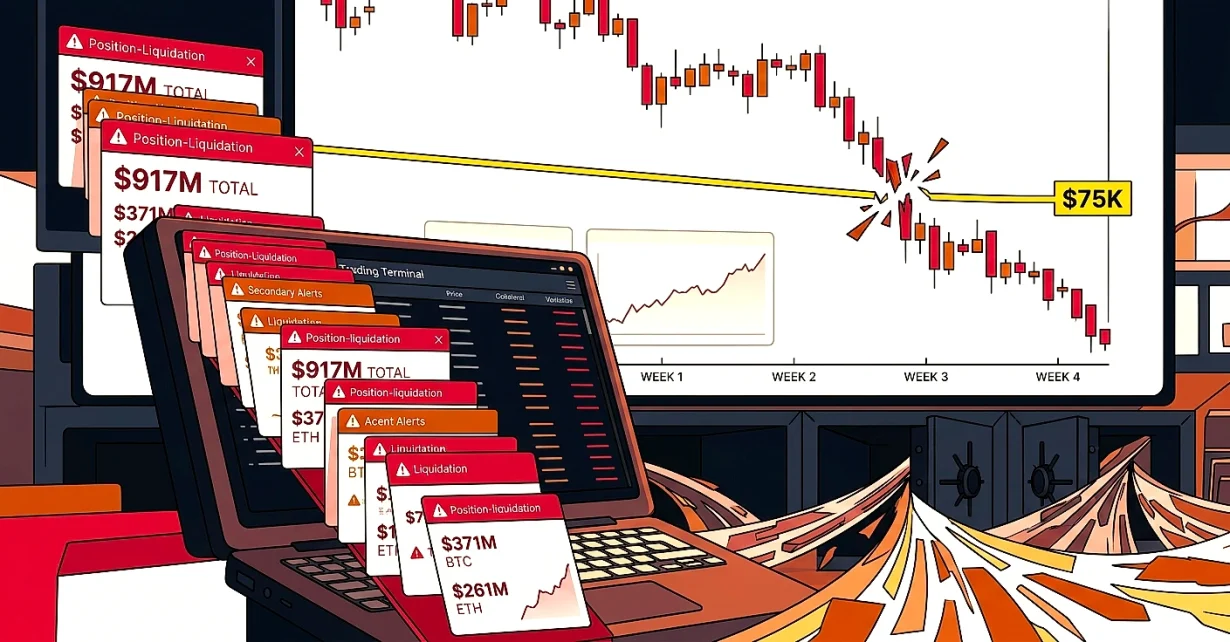
Token Metrics technicals read neutral as Bitcoin breaks below $75,000, triggering $917M in liquidations. The drop happened during six straight days of ETF outflows totaling over $1.25 billion. Token Metrics Daily Pulse coverage flagged this as a lead change in market structure. The token-market signal shows no clear directional bias as BTC trades in its recent range.
Context
Bitcoin’s slide below $75,000 marks its lowest price since late April 2026. The cryptocurrency had been trading above $80,000 just last week. This shows how quickly market sentiment can shift in crypto. The latest leg down continues a broader market dip that began several days ago. Other major tokens followed Bitcoin lower.
The price action happens during a rough stretch for Bitcoin ETFs. The funds have seen six consecutive days of outflows. These outflows totaled over $1.25 billion according to Farside Investors. This sustained selling pressure from institutional products has weighed heavily on Bitcoin’s price. ETF flows now represent a significant driver of market dynamics.
Rising U.S. Treasury yields may be contributing to the ETF outflows. These outflows then cascade into Bitcoin price pressure. Yellow Capital CEO Diego Martin explained to Decrypt how the market has changed. “Geopolitical shocks no longer hit crypto directly the way they once did. They hit Treasury yields, which hit risk appetite, which hits ETF flows, which hit Bitcoin. The transmission is more institutional now.”
The liquidation data from CoinGlass shows the severity of the market reaction. Long positions dominated the liquidations with $827 million worth of forced closures. This indicates many traders were caught off guard by the sudden downturn.
Historical parallels exist for such market moves. In similar corrections during 2023 and 2024, Bitcoin often found support after breaking key psychological levels. The current smart-money netflow data suggests institutional players are gradually repositioning rather than exiting entirely. This pattern typically precedes a consolidation phase before the next directional move.
Regulatory factors also play a role. Recent SEC clarity on crypto ETF rules has helped institutional participation grow. This makes ETF flows more important than ever for price discovery. The current outflow streak represents the longest since the ETFs launched in 2024.
What Token Metrics Data Shows
Data as of May 23, 2026.
Token Metrics technicals on Bitcoin read neutral. The trend has no clear directional bias. The token is trading sideways inside its recent range. This neutral signal suggests investors should wait for confirmation before taking new positions. The market lacks conviction in either direction.
Momentum sits weak but not stretched. The reading of 46 indicates selling pressure but not yet oversold conditions. This gives Bitcoin room to fall further without becoming extremely cheap. Traders often look for readings below 30 as a buy signal.
Volatility is running moderate. The measure shows daily moves around 2% have been common. The market isn’t pricing in an explosive move either way. This suggests calm conditions despite the price drop. Options traders aren’t demanding big premiums for protection.
First support sits near $72,400. This level aligns with previous consolidation zones from earlier this year. A break below could trigger more selling as stop-loss orders activate. The next resistance near $80,400 represents the recent high range.
Bitcoin is trading near $75,400. It’s down about 2% on the day and off roughly 4% over the past week. The market cap stands around $1.51 trillion. This shows how a few percentage point moves still involve billions of dollars in value creation or destruction.
Token Metrics Daily Pulse flagged this as a lead change in the macro section yesterday. The Daily Pulse coverage noted the shift in market structure. Bitcoin broke key support levels. The combination of ETF outflows and rising Treasury yields created a perfect storm for the recent weakness.
The token-market signal remains mixed. Smart-money netflow data shows moderate outflows but not panic selling. Large holders appear to be accumulating at these levels. This divergence between price action and holder behavior often signals a potential bottom.
Polymarket consensus currently assigns a 35% chance of Bitcoin dropping below $70,000 within the next month. This reflects elevated but not extreme bearish sentiment. The prediction market has been a reliable gauge of retail sentiment during previous volatility events.
What’s New
The immediate trigger appears to be Bitcoin breaking below $75,000 support. The dip happened in early Saturday trading. It reached as low as $74,344 before finding buyers. This level hadn’t been tested since April 2024, making it a significant psychological barrier.
The ensuing liquidation cascade wiped out nearly $1 billion in leveraged positions. Bitcoin futures led with $371 million in forced closures. Ethereum futures contributed another $261 million. The dominance of long liquidations suggests many traders were betting on continued upside.
Other major cryptocurrencies showed similar declines. Ethereum fell 2.7% to around $2,059. Solana declined over 3% to $84. The broad-based nature indicates this wasn’t just a Bitcoin-specific event. It was a market-wide risk-off move.
CoinGlass data shows the liquidation breakdown. Long positions accounted for 90% of total liquidations. Short positions only saw $90 million in closures. This asymmetry confirms the market was heavily positioned for higher prices before the reversal.
The liquidation intensity peaked between 2:00 AM and 4:00 AM UTC. This timing suggests algorithmic selling triggered the cascade. Human traders typically are less active during these hours. The bounce began as Asian markets opened around 6:00 AM UTC.
What to Watch
• Watch for a potential reversal if Bitcoin reclaims $75,000. This level now acts as resistance. A break above could trigger short covering. The level has flipped between support and resistance multiple times recently.
• Monitor daily ETF flow data from Farside Investors. A break in the six-day outflow streak would signal institutional sentiment is turning. Inflows of over $100 million would be particularly bullish.
• Keep an eye on U.S. Treasury yields. Further increases could continue to pressure risk assets. The 10-year yield above 4.5% has historically correlated with crypto weakness.
• Track liquidation data on CoinGlass. Daily totals below $200 million would suggest the forced selling wave is subsiding. This typically precedes more stable price action.
• Watch the $72,400 support level. A break below could signal further downside toward $70,000. This level represents the last major support before a deeper correction.
• Pay attention to smart-money netflow patterns. Sustained inflows to large holder addresses would confirm accumulation. This divergence from price often precedes bottoms.
This content is for informational purposes only and should not be considered financial advice.