

TL;DR
Token Metrics technicals read bearish as Sui Network recovers from a six-hour outage caused by a bug in its 1.72 release update. The network’s validators are still showing degraded performance. SUI token fell about 6.6% to 90 cents during the outage before bouncing back slightly as the network works to restore full operations.
Context
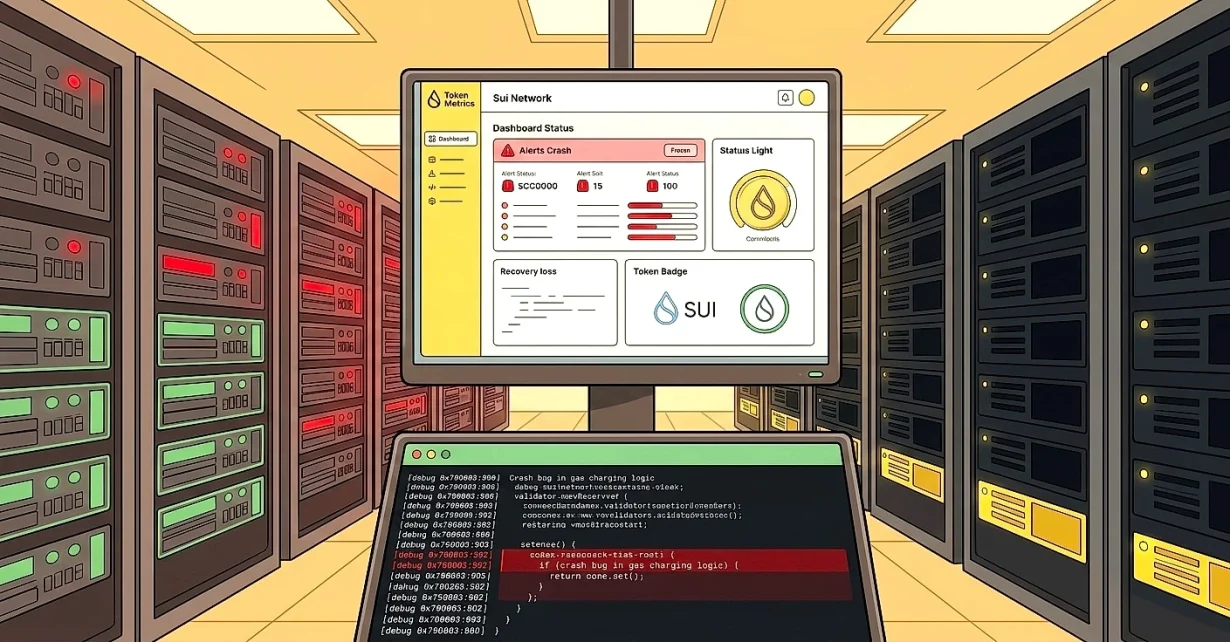
Sui Network, a layer-1 blockchain launched in May 2023, went offline for 5 hours and 55 minutes on Thursday. The outage stemmed from what Sui called a “crash bug in the gas charging logic introduced by the 1.72 release.” The network had earlier warned users about a network stall and paused transactions until a fix could be deployed.
This marks the second major outage for Sui in 2026. The blockchain experienced a similar incident in January that knocked it offline for more than six hours. Another disruption occurred in November 2024, when validators were stuck in a crash loop for about two and a half hours. Despite these technical challenges, Sui remains the 13th-largest blockchain by total value locked at $542 million. Hosting 137 protocols according to DefiLlama data.
Sui launched its mainnet in May 2023. Earlier this month, the SUI token had seen positive developments. A Nasdaq-listed company staked a large portion of the supply. Developers announced upcoming features including zero-fee stablecoin transfers and private transactions.
The network has faced regulatory scrutiny in various jurisdictions as it expands globally. Similar blockchain outages in the past have led to increased oversight from regulators concerned about market stability. The January outage prompted discussions among industry leaders about the need for better testing protocols before major updates.
What Token Metrics Data Shows
Data as of May 29, 2026. SUI is trading near 92 cents, up about 1.5% over the past 24 hours but down roughly 17% over the past week. Token Metrics technicals read bearish across the board. The trend remains bearish with no recent trend crossover. The token is trading sideways inside its recent range, with momentum sitting weak but not yet stretched. Volatility is running hot at nearly 6% of spot price, suggesting traders are pricing in uncertainty. First support sits near 75 cents, next resistance near $1.24.
The token-market signal shows bearish momentum with momentum indicators reading in the low 40s. This indicates that selling pressure has been strong but the asset is not yet oversold. The smart-money netflow shows mixed sentiment, with the 7-day trend negative despite the recent price stabilization. Polymarket consensus reflects uncertainty about Sui’s short-term performance following the outage. Daily Pulse coverage highlights the network’s struggle with technical stability despite its growing world.
Technical indicators suggest further downside potential. The bearish trend bias combined with weak momentum points to possible continuation of the downtrend. The elevated volatility at nearly 6% of spot price indicates that traders expect more price swings ahead. The support level at 75 cents could be tested if selling pressure continues. Resistance at $1.24 would need to be broken to signal a trend reversal.
The 7-day price decline of nearly 17% shows that the outage has significantly impacted investor confidence. The 1.5% 24-hour gain indicates some short-term stabilization, but the overall bearish technical picture suggests caution. The mixed smart-money netflow indicates that institutional traders are divided on the token’s near-term prospects.
What’s New
The Sui mainnet resumed operations Thursday evening after the crash bug fix was deployed. The network’s status page confirmed the 5 hour and 55 minute outage duration. Though validators are still experiencing “degraded performance.” This suggests the network may not be operating at full capacity even though transactions are processing again.
The SUI token reacted sharply to the outage, dropping about 6.6% to a low of 90 cents during the downtime according to CoinGecko data. The token has since recovered slightly. This price action reflects ongoing concerns about network reliability despite the protocol’s recent technical advancements.
Sui developers had been touting upcoming features including zero-fee stablecoin transfers and private transactions. These features aim to improve the network’s utility for both retail and institutional users. However, repeated outages could undermine confidence in the network’s ability to support these ambitious plans.
The incident review promised by Sui will be crucial for understanding how similar bugs can be prevented. The gas charging logic bug appears to be related to how transaction fees are calculated and processed. This core function failure raises questions about the network’s testing procedures for critical updates.
Historical Parallels
Network outages have affected other major blockchains in recent years. Solana experienced multiple outages in 2022 that lasted several hours each. These incidents led to significant price drops and loss of user confidence. Polygon also faced downtime issues in 2021 that required network restarts.
The Sui outage pattern mirrors these past events. Initial technical issues followed by price pressure and gradual recovery. The January 2026 Sui outage lasted over six hours, similar to Thursday’s incident. The November 2024 incident was shorter at 2.5 hours but still caused significant disruption.
Other layer-1 blockchains have taken months to fully restore user trust after multiple outages. Ethereum’s 2016 DAO hack required a hard fork that split the community. More recently, Avalanche faced network congestion issues in 2023 that took weeks to resolve fully.
What to Watch
- Monitor Sui’s status page for when validators return to normal performance levels from degraded status.
- Watch for the full incident review promised by Sui, which should detail the root cause and prevention measures.
- Track SUI’s ability to reclaim the $1 level, which could signal renewed confidence after the outage.
- Observe whether smart-money netflow turns positive on a 7-day basis, indicating institutional return to risk.
- Pay attention to any impact on trading volumes following the outage, as institutional response will be telling.
- Look for announcements about improved testing protocols or delayed feature releases due to the outage.
- Watch for competitor blockchains to highlight their reliability in marketing materials following this incident.
This content is for informational purposes only and not financial advice.